Real IPs. No port-forwarding.
klimax adds a single macOS route into the kind bridge subnet. Pod IPs, ClusterIPs, and MetalLB LoadBalancer VIPs are reachable directly from your Mac — curl http://172.30.1.200/ just works.
klimax spins up kind clusters on your Mac in under a minute, and routes their real IPs directly into your laptop — pods, ClusterIPs, LoadBalancer VIPs. No port-forwarding. No SNAT. No VPN.
$ klimax up
✓ Lima VZ instance ready          (38s)
✓ Docker provisioned              (4s)
✓ macOS route 172.30.0.0/16        added
✓ Registry mirrors                 docker · quay · gcr

$ klimax cluster create dev
✓ kind cluster dev                  api :7001
✓ MetalLB pool                     172.30.1.16-254
✓ kubeconfig merged                ~/.kube/config

$ kubectl apply -f nginx.yaml
deployment.apps/nginx created
service/nginx exposed

$ kubectl get svc nginx
NAME    TYPE           EXTERNAL-IP       PORT(S)
nginx   LoadBalancer   172.30.1.200      80:31408/TCP

$ curl http://172.30.1.200/
<h1>Welcome to nginx!</h1>  ← from your Mac, no port-forward
▌
Why
Years of running kind clusters on a MacBook, distilled into one CLI. klimax inherits the engine that the cool kids run on (Lima + Apple VZ) and adds the missing layer: real-IP routing, multiple clusters side by side, and pull-through registry caches.
klimax adds a single macOS route into the kind bridge subnet. Pod IPs, ClusterIPs, and MetalLB LoadBalancer VIPs are reachable directly from your Mac — curl http://172.30.1.200/ just works.
Each cluster gets its own API port, service subnet, pod subnet, and MetalLB pool slice. Run dev, staging, and prod side by side on the same VM. Switch with kubectx.
Built on Lima's VZ driver — Apple Virtualization framework, vzNAT networking, virtiofs mounts. Cold start under a minute. No Hypervisor.framework overhead, no qemu emulation.
Pull-through mirrors for docker.io, quay.io, gcr.io ship pre-configured. Cluster image pulls hit local disk after the first run. Goodbye Docker Hub rate limits.
One Go binary. Downloads the Lima guest agent on first run and caches it. No limactl, no kind, no docker CLI required on the host.
Coexists with OrbStack, Docker Desktop, Colima, and Rancher Desktop. A single flag (disablePortMirroring) sidesteps Lima port-mirroring conflicts when other Lima VMs are running.
Demo
One command brings up the VM, installs Docker, wires the routing, and starts the registry mirrors. A second command creates a cluster and merges its kubeconfig. That's the whole workflow.
Under the hood
Your Mac, a Lima VZ guest, and a Docker bridge — that's the entire topology. klimax adds a host route into the kind bridge CIDR, an iptables nat-exemption inside the VM, and DOCKER-USER forward rules so kind→host traffic exits without SNAT. Source IPs are preserved end to end.
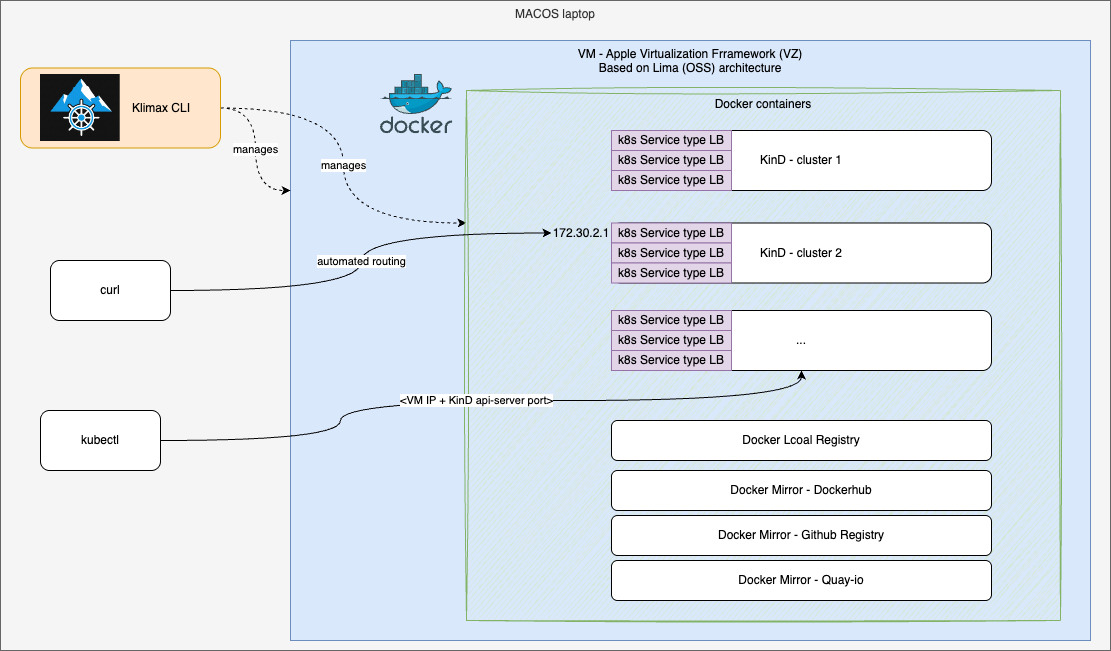
curl 172.30.1.200/ on your Mac → vzNAT → guest lima0 → Docker bridge → MetalLB VIP. No SNAT, no port-forwarding, no VPN.
One host route (172.30.0.0/16 → lima0). iptables nat-exemption inside the VM. A docker.service.d drop-in re-applies the rule after every restart.
--num N assigns the API port (700N), service subnet (10.N.0.0/16), pod subnet (10.1N.0.0/16), and a MetalLB pool slice.
One local push registry + three pull-through mirrors. Cache lives at ~/.klimax/registry-cache/ and survives klimax destroy.
Bonus
klimax-ui is a SwiftUI companion app: a dashboard for every cluster, registry, and VM resource klimax manages — with live charts, kubeconfig copy buttons, and a one-click cluster creator.
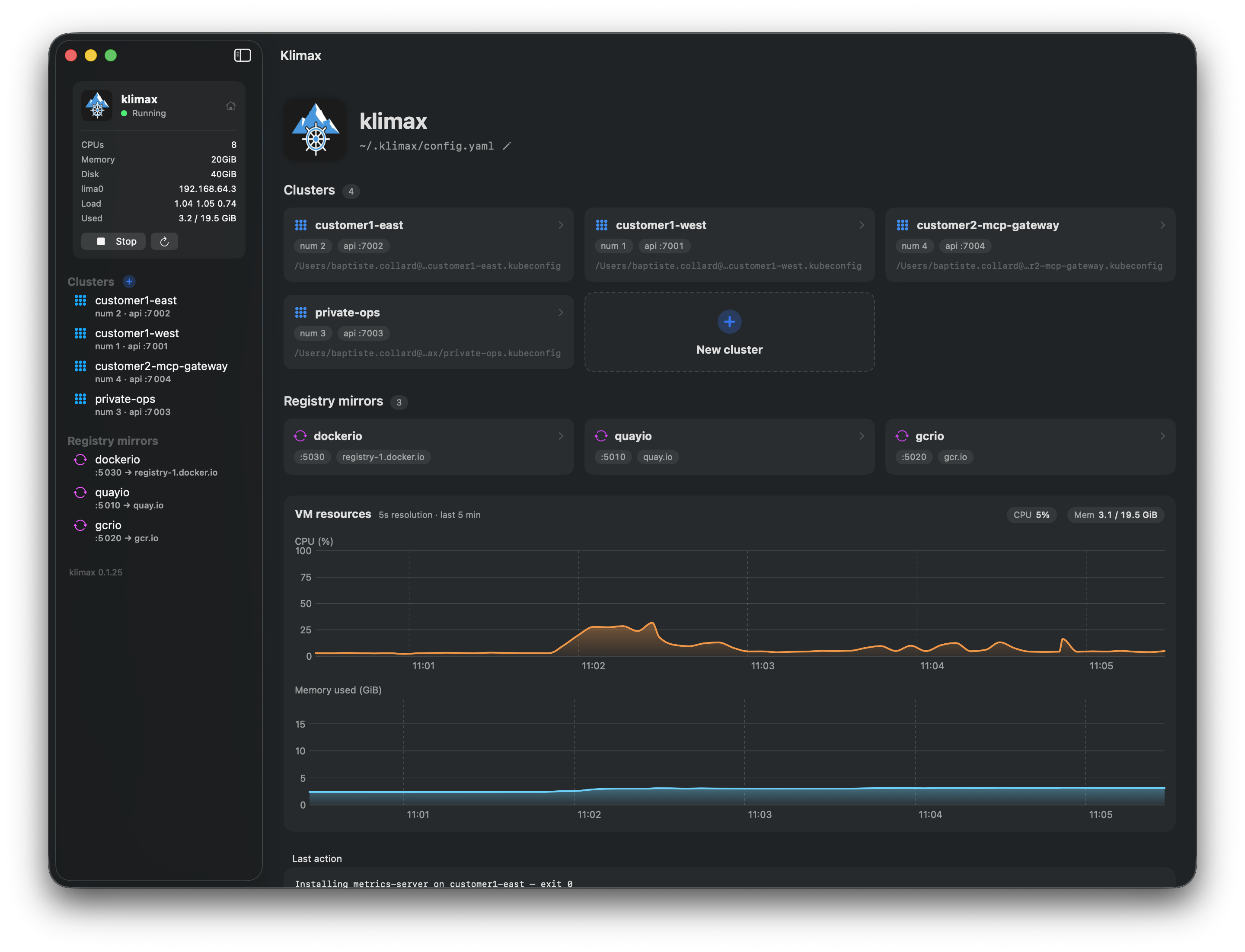
Cluster overview. Every kind cluster, its API port, kubeconfig path, and quick actions in one place.
Live VM charts. CPU, memory, and disk for the Lima guest — pulled straight from inside the VM.
Registry mirror inspector. Cache size, hit/miss counters, and a one-click clean cache.
Built on the same CLI. The UI shells out to klimax — no parallel state, no drift.
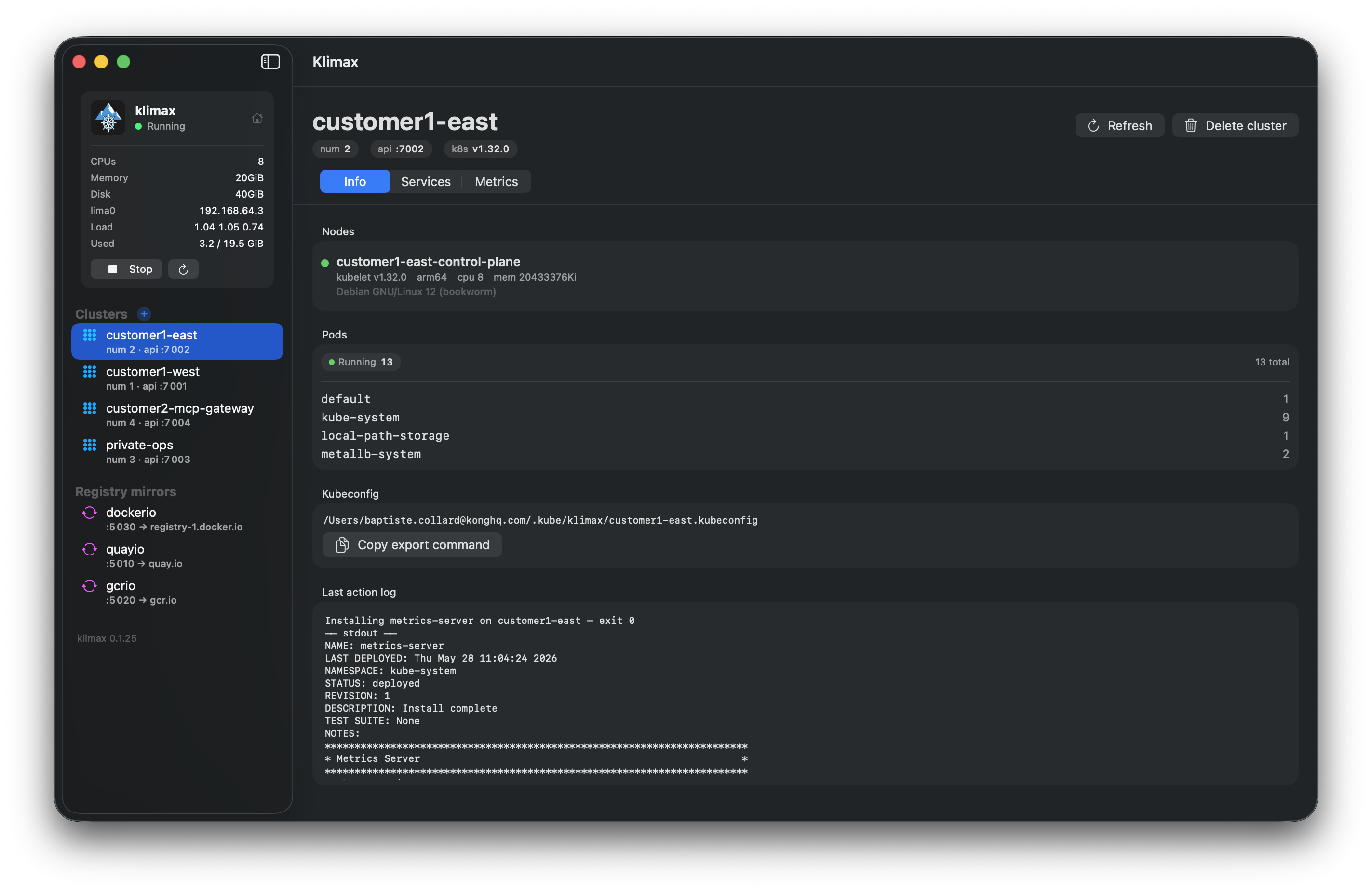
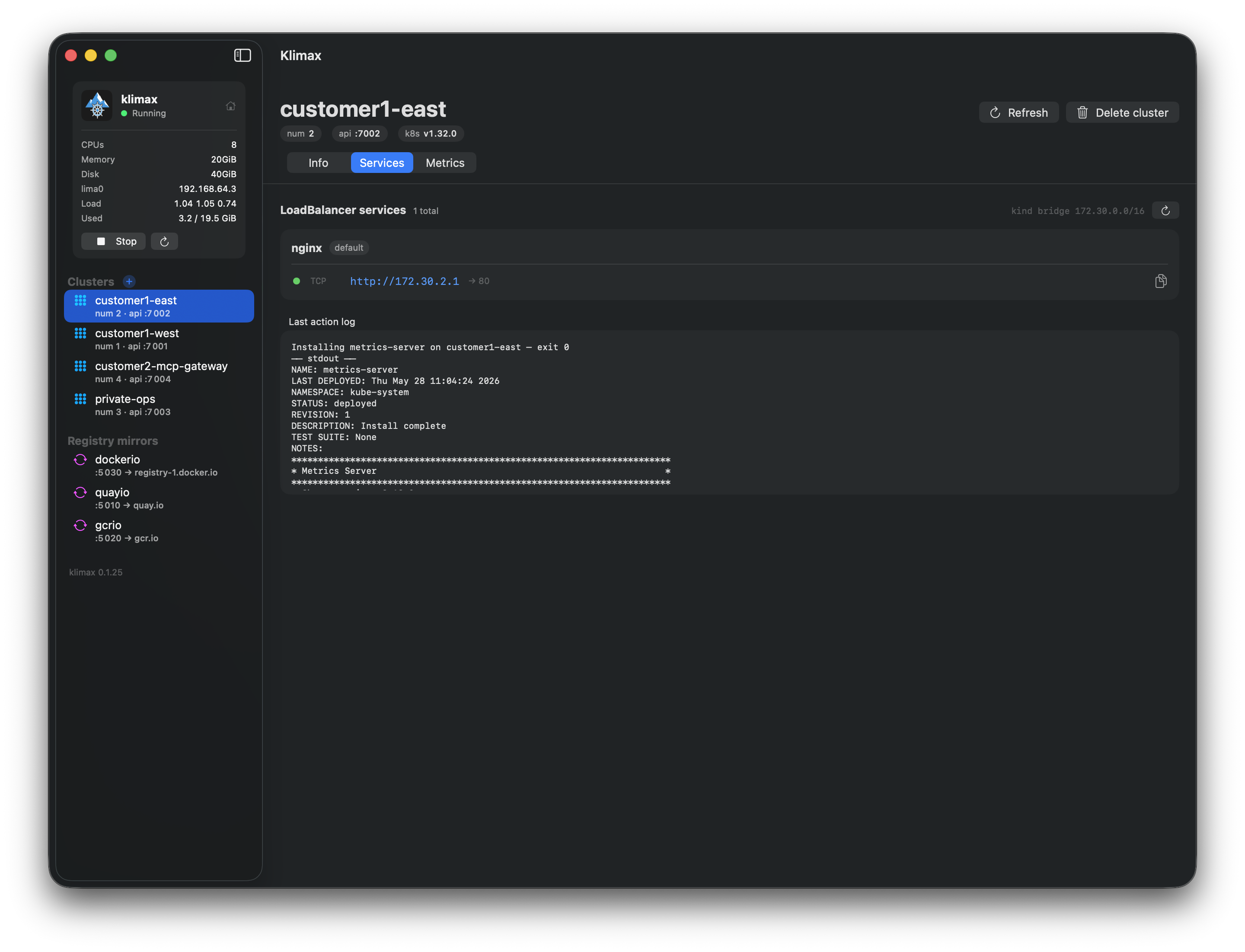
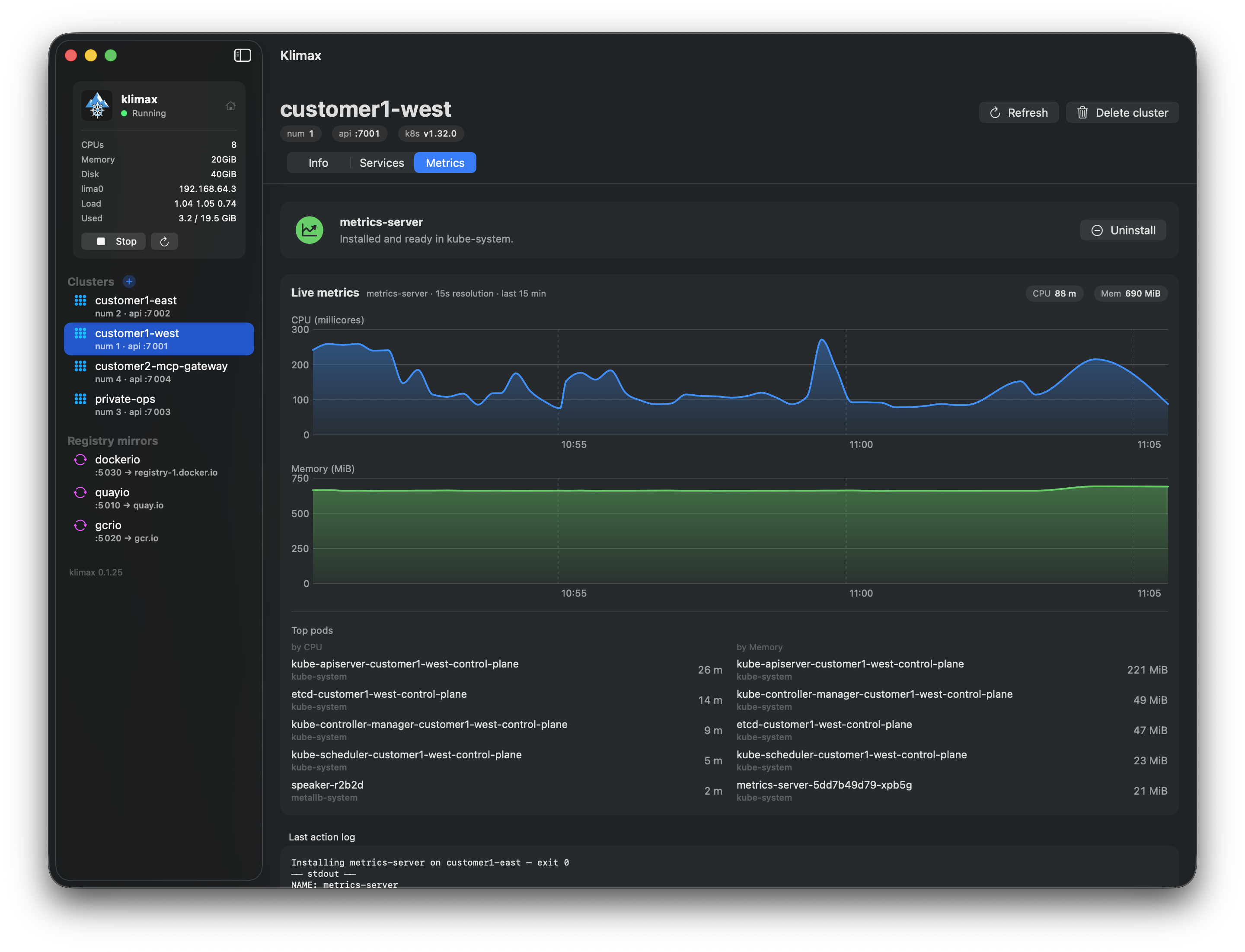
klimax-ui is open source. Releases coming soon — for now, build from source from the klimax-ui repo.
Get it
$ brew tap bcollard/klimax
$ brew install --cask klimax
$ klimax up# Bring up the VM + Docker + routing + registries (idempotent)
$ klimax up
# Create clusters
$ klimax cluster create dev
$ klimax cluster create staging
# List, switch, delete
$ klimax cluster list
$ kubectx dev
$ klimax cluster delete # interactive multi-select picker
# End-to-end smoke test
$ klimax cluster e2e-test-nginx
# Stop the VM (preserves clusters and registry cache)
$ klimax downFAQ
Those each solve one piece of the puzzle. klimax is opinionated about the whole stack: a single CLI that owns the VM, the kind clusters, the routing, the registry mirrors, and the kubeconfig wiring. The killer feature is real-IP routing: you reach pod IPs and LoadBalancer VIPs directly from your Mac without port-forwarding. See the detailed comparisons in the repo.
Yes. klimax runs its own Lima VZ instance with a distinct vzNAT IP, so there is no IP-level conflict with other VMs. The one friction point is Lima port mirroring — set network.disablePortMirroring: true in ~/.klimax/config.yaml when running alongside other Lima-based tools that also manage kind clusters, and kubeconfigs will use the VM's direct lima0 IP instead of 127.0.0.1.
macOS 13 Ventura or later — Apple Virtualization framework (vmType: vz) is required. Built and tested on Apple Silicon.
sudo?Only twice: klimax up adds a macOS host route (route add 172.30.0.0/16 …), and klimax destroy removes it. Everything else — VM lifecycle, cluster create/delete, registries — runs unprivileged.
Yes. klimax down stops the VM but preserves every cluster, its data, and the registry cache. klimax up brings them all back. klimax destroy is the explicit wipe.
No — that's exactly what the pull-through mirrors fix. After the first pull, blobs are served from ~/.klimax/registry-cache/ on your laptop. The mirrors survive klimax destroy.
Yes. Add username / password under any mirror in ~/.klimax/config.yaml. The local push registry is at kind-registry:5000 from inside the cluster — push with docker push kind-registry:5000/myimage:tag.
